


Harmony & composition · VST3 · AU · Standalone
MODALITHHarmony & Composition
Pick a key and see every chord that belongs to it, coloured by what it does. Build a progression while the next chord lights up, or start from more than 2,000 progressions. Then turn it into a song with chords, bass, melody and arpeggio on your own instruments, and drag it into your DAW.
- Windows 10 / 1164-bit · VST3 · Standalone
- macOS 11 or newerIntel and Apple Silicon · AU · VST3 · Standalone
- Logic Prowith the MODALITH MIDI FX version
- Not available as AAX (Pro Tools)

How it works
From the first chord to a finished song
Start wherever you are: a riff under your fingers, a recording, a style you love or an empty page.
- 1Find the keyPick it on the circle of fifths, play a few bars, or load a recording, and MODALITH tells you the key.
- 2Build the progressionClick chords that fit, follow the Guide, pick one from the Library or generate a new one.
- 3Arrange the songSections on a timeline, each with its own chords, plays and key, and four lanes on your instruments.
- 4Drag it into your DAWThe whole song as MIDI with a track for each lane, or one lane at a time.
Tutorial
Every feature in under 8 minutes
A tour of the real plugin, from the first chord to a whole song dragged into your DAW as MIDI.

Chords in the key
Every chord in your key, and what it does
Pick a key on the circle of fifths and its chords line up in a row, each with its Roman numeral and its role: home, moving away or pulling back. Below them sit the colour chords songs use all the time: chords borrowed from the minor or major key, chords that lead into another one, and more. Click a card to hear it, double-click or drag it to add it.

The Guide
The next chord lights up
While you play, the chords that could come next pulse in their own colour right on the palette. The strongest move pulses most and wears a 1, the next two pulse gently, the rest glow softly. Below, Next in shows the same choices for the style you pick, from pop and rock to jazz, gospel or trap, and tells you why when you point at one.

Colours and variations
Sus, add9, 6 and more, one click away
Give the whole palette a colour: sus2, sus4, add9 or 6 on top of triads, sevenths or ninths. Right-click any chord for its variations, such as 7sus4, 6/9, m(add9) or maj7#11, the ones in your key first. Point to hear one, click to add it or to swap the chord you selected. A dashed card tells you the colour steps outside the key.

Progression library
More than 2,000 progressions, always in your key
21 styles and 26 families: jazz turnarounds, blues forms, four-chord pop loops, intros, key changes and many more. Search by name, style or mood, star your favourites, save your own progressions and find more like the one you love. Every card has variants: written out longer, half or double time, another voicing or rhythm. Drag any of them straight into your song.

Generate
A fresh progression in your style
Choose a style, a mood, a length and how rich the chords should be, and press Listen first to hear a new progression without touching yours. Like it? Generate keeps exactly that one. Make it loop back to the start, or end at home. Whatever it writes is your own: it never copies a song.



Instrument views
See it on the instrument you play
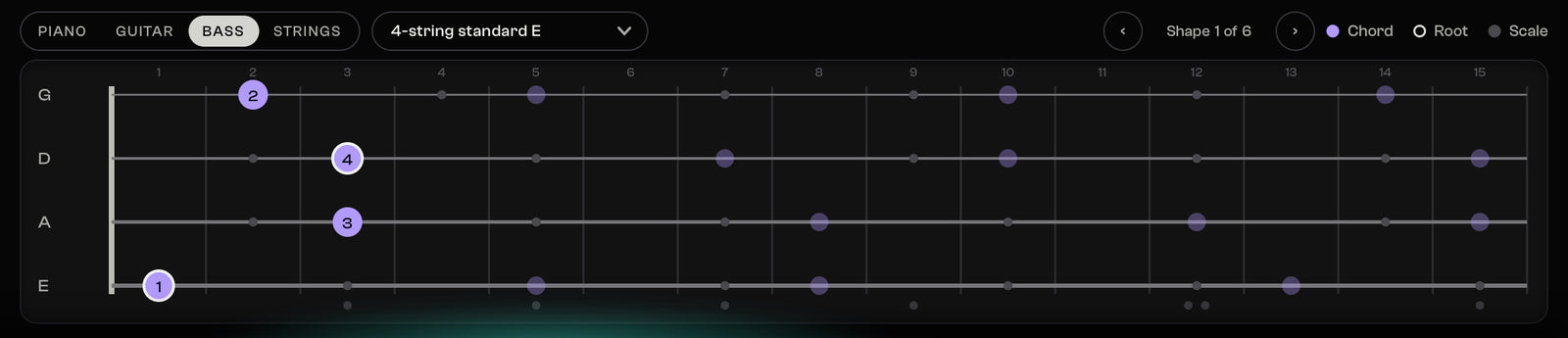
Every chord on piano, guitar, bass or strings. Playable guitar and bass shapes with the fingers and the barre, in 21 tunings for 6, 7 and 8 strings and 4, 5 and 6 string bass. Voicings for a string orchestra, a string quartet, a choir or a brass section, every part in its comfortable range and moving smoothly from chord to chord.

The song
Arrange it on a timeline
Intro, verse, chorus, bridge and outro sit on a timeline, each as wide as it plays. Give a section its own key, repeat it or drag it to a new place. Drag a chord's edge to make it longer or shorter and the chords after it move along. Drop chords in from the palette or the Library and see exactly where they land.

Four lanes
Chords, bass, melody and arpeggio on your instruments
Each lane has its own pattern, register and sound: strums, walking bass, arpeggios and a melody sketch to build on. Load your own instrument and effect plugins on every lane, or choose one main Sound that plays everything you try out. A section can play its lanes its own way, and swing and feel make the parts sound played. If a plugin crashes, only its sound goes quiet.

Into your DAW
Play it, loop it, drag it out
Play and stop with the space bar, loop the whole song or only the chords you select, set the tempo, a click and a count-in. In your DAW, MODALITH follows its play, position and tempo. Drag the whole song into your DAW as MIDI with a track for each lane, or one lane at a time; every lane also plays out on its own MIDI channel.
Chords from audio
Hear a song, get its chords
Load a recording, or let MODALITH listen to a track in your DAW or to your audio input. It finds the key, the tempo and the chords and turns them into a progression you can edit, play and drag out.
- Honest about doubts. Chords it is not sure of are marked, with its second choice one click away.
- Ready to change. The result is a normal progression: swap a chord, follow the Guide, change the key.
- Your demo, your jam. Turn a voice memo or a rehearsal into chords you can build on.

Music theory, done for you
It knows why a chord works
Not just chord names: MODALITH shows what each chord does in the key, so you learn while you write.
Delivery and compatibility
In your DAW, or on its own
- Windows
- Windows 10 / 11, 64-bit · VST3 and standalone app
- macOS
- macOS 11 or newer, Intel and Apple Silicon · AU, VST3 and standalone app
- Logic Pro
- Uses the MODALITH MIDI FX version in the MIDI FX slot, included in the download
- Not available
- as AAX (Pro Tools)
- Audio files
- WAV, AIFF, FLAC, MP3 and Ogg for chords from audio
- MIDI
- Drag the whole song (a track per lane) or a single lane, or export a MIDI file
- In the download
- Windows installer, macOS installer and the User Guide (PDF)
- Licence
- One-time purchase, no subscription, no activation · included in the All-Access Pass
Built on open music data
Where the progressions come from
MODALITH learned how chords move from openly licensed collections: the McGill Billboard chord annotations (CC0), the Rock Corpus by Trevor de Clercq and David Temperley (CC BY 4.0), the Weimar Jazz Database of the Jazzomat Research Project (ODbL) and our own analysis of public-domain scores from OpenScore Lieder (CC0) and PDMX (CC BY 4.0). No song or artist name is stored in the plugin.
Full credits are in the plugin’s About screen and in the User Guide.
Questions
Frequently asked
Do I need to know music theory to use MODALITH?
No. Click chords that fit, follow the Guide or start from a ready progression without knowing any theory. If you want to learn, MODALITH shows what each chord does in the key, so the theory comes to you while you write.
Which styles and instruments does it cover?
More than 2,000 progressions in 21 styles, from pop, rock, jazz and classical to gospel, film, EDM, trap, lo-fi, K-pop and metal. You see every chord on piano, guitar (6, 7 and 8 strings in 21 tunings), bass or a string section, choir or brass.
Can it find the chords of a song I recorded?
Yes. Load a WAV, AIFF, FLAC, MP3 or Ogg file, or let MODALITH listen to a track or your audio input. It finds the key, the tempo and the chords as a progression you can edit. Chords it is not sure of are marked, with its second choice one click away.
How do I get the chords and parts into my DAW?
Drag the whole song onto your tracks (one track per lane) or a single lane, or export a MIDI file. In DAWs that route a plugin's MIDI to other tracks, each lane also plays out on its own MIDI channel. With Sync to host on, MODALITH follows your DAW's play, position and tempo.
Does it work in Logic Pro?
Yes. Load MODALITH as an instrument to hear the lanes through the instruments you load inside it, or put MODALITH MIDI FX in a track's MIDI FX slot to drive that track's instrument. To get the parts onto their own tracks, drag them out as MIDI.
Can I use my own instruments?
Yes. Load your own instrument and effect plugins on every lane, and choose one main Sound that plays everything you try out. Each plugin runs on its own: if one crashes, only its sound goes quiet and Restart brings it back.
Are the progressions copied from famous songs?
No. They are learned from openly licensed collections of chord changes and from public-domain music, and no progression repeats five or more chords in a row from any song in those collections. Short loops that everyone uses, like the classic four-chord loop, are common property and stay in.
Is it a subscription? Does it work in Pro Tools?
No subscription: you pay once, with no activation, and MODALITH is included in the All-Access Pass. It is VST3, AU and a standalone app, not AAX, so it does not load in Pro Tools; with Pro Tools, write in the standalone app and bring the song over as a MIDI file.
MODALITH
Know your chords. Write the song.
Develop Device All-Access Pass
Why buy one plugin at a time?
One annual pass unlocks the entire Develop Device catalogue, plugins, presets, DAW templates, drum MIDI, cabinet IRs and amp profiles, including this product, plus everything new I release this year. A fraction of buying it piece by piece.
- Every Develop Device plugin & app, including this one
- Serum 2 & Vital synth preset toolkits
- Superior Drummer 3, EZdrummer, GGD, MODO & Addictive Drums presets
- DAW templates for Cubase, Studio One & Reaper, plus 30K+ drum MIDI
- Cabinet IRs, NAM profiles & presets for Fractal, Kemper & Ampero
- Quad Cortex captures, shared straight to your Cortex Cloud
- Every new Develop Device release during your active year
- What you unlock stays downloadable, even after your year ends