


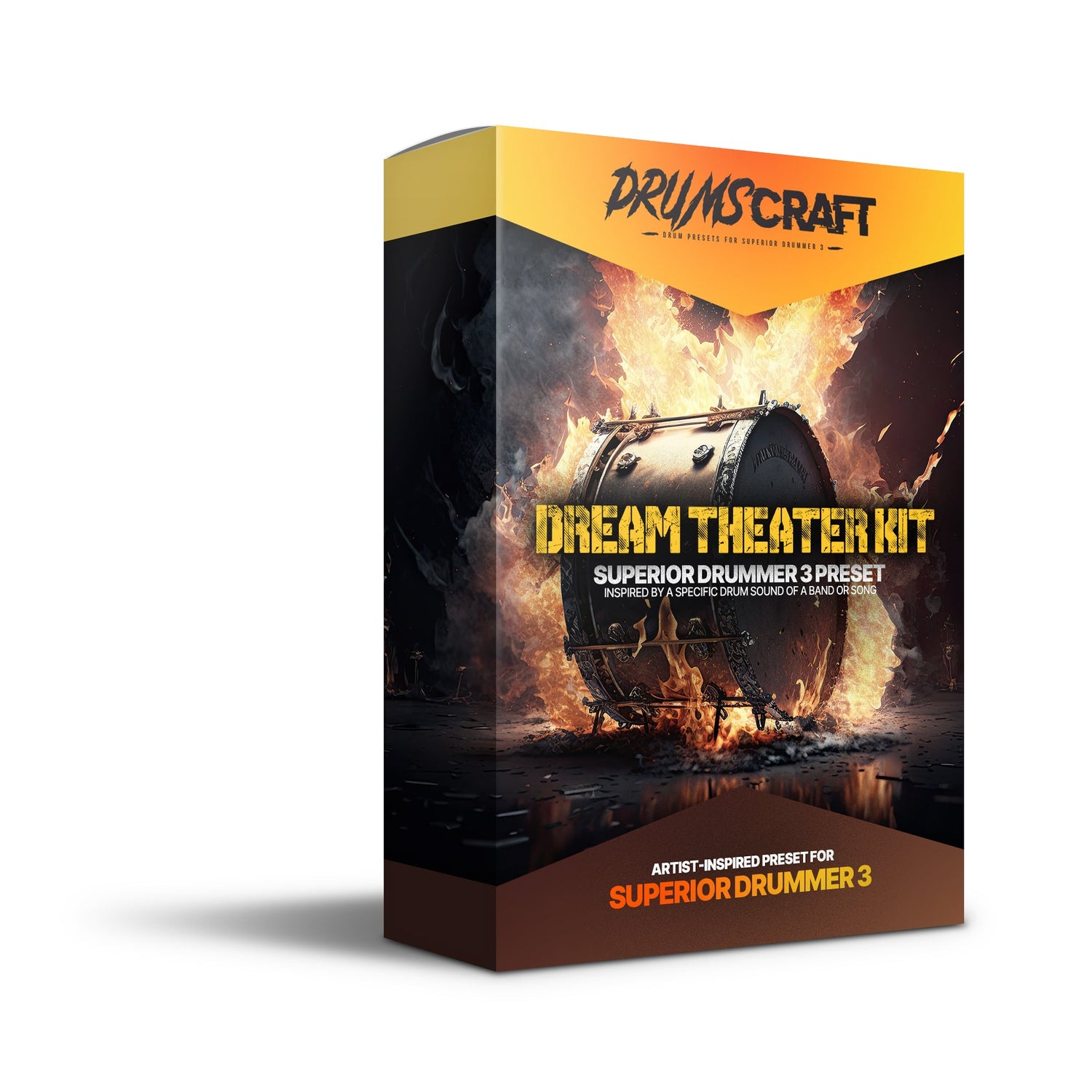
The Dream Theater drum sound is harder to copy than it looks because there isn’t one. Mike Portnoy played on ten studio albums between 1989 and 2009, Mike Mangini played on five between 2011 and 2021, and Portnoy returned for Parasomnia in 2025. Three decades of progressive metal, two distinct drummers, multiple production philosophies. To recreate the Dream Theater drum set in Superior Drummer 3, the first thing to decide is which Dream Theater you mean.
This guide splits the work along those reference points and dials each one in.
The Two Eras of the Dream Theater Drum Sound
Pick your target era before you touch a single fader.
Portnoy era (1989–2009):
- Rounder kick with more low-mid weight and a slightly slower attack.
- Ringing, characterful snare — body before crack.
- Four to five toms, with audible stick tone and shell sustain.
- Larger room ambience; recordings breathe.
- Wider dynamic range — Portnoy hits hard, then drops to ghost notes inside the same bar.
Mangini era (2011–2021):
- Tighter, faster kick transient; less low-mid bloom.
- Snare leans toward articulation and crack over body.
- Six- or seven-tom kits with rapid melodic runs that demand cleaner sustain control.
- Drier, more controlled close-mic balance.
- Compression sits more aggressively on the room mics.
Same band. Different production philosophies. The sections below refer back to that choice.
Best SDX Libraries for Dream Theater Drums
The library that maps cleanest onto a modern Portnoy sound is Hitmaker SDX. It captures rock-leaning kits with the body and stick definition that Dream Theater records sit on, and its kit options give you enough flexibility to cover both heavy and dynamic passages without swapping libraries mid-song.
For Portnoy-era warmth from the original tenure, The Rooms of Hansa SDX layered in at low ratios adds natural tracking-room ambience — useful when the close mics on Hitmaker alone sound too tight.
For the Mangini-era articulation, Decades SDX can supplement Hitmaker when you want a snappier snare or quicker tom decay. It is a layer, not a replacement.
If your work spans other prog styles, the Progressive Area Kit: Superior Drummer 3 Preset is a useful cousin preset for general progressive rock and metal applications, and ships with a different tonal balance you can A/B against.
Kick Drum Settings
The kick is where the era split shows up most. Both setups start from the same EQ skeleton, then diverge on the transient stage.
Shared EQ:
- High-pass at 30 Hz to remove subsonic rumble.
- Cut 4–6 dB at 250 Hz to pull boxiness.
- Boost 2–3 dB at 60–80 Hz for weight.
Portnoy: boost 3 dB at 2.5 kHz for the beater attack. Transient designer attack +1 to +2, sustain neutral. Compression 4:1, attack 15 ms, release medium-fast.
Mangini: boost 5 dB at 4 kHz for the click. Transient designer attack +3 to +4, sustain −2 to tighten the tail. Compression 4:1, attack 5 ms, release fast.
A 1 ms attack-time difference on the compressor is the difference between the kick on Octavarium and the kick on A Dramatic Turn of Events.
Snare Drum Settings
The snare is the second-biggest tell.
Portnoy-era snare (Six Degrees, Train of Thought, Black Clouds):
- Boost 3 dB at 200 Hz for body.
- Cut 2 dB at 500 Hz to clear room for guitars.
- Boost 2 dB at 4 kHz for stick attack.
- Top mic to bottom mic ratio: roughly 75/25.
- Light compression — 3:1 at 25 ms attack to preserve the initial transient.
Mangini-era snare (Distance Over Time, A View from the Top of the World):
- Boost 2 dB at 220 Hz, but cut another 1 dB at 700 Hz.
- Boost 3 dB at 5 kHz and a 2 dB shelf above 8 kHz.
- Top to bottom ratio: 70/30 — slightly more wires.
- Heavier compression — 4:1 at 15 ms attack, with a parallel chain at 8:1 for crack.
Skip the dial-in: the Dream Theater Kit: Superior Drummer 3 Preset loads all of this against Hitmaker SDX in one click — kick, snare, toms, room, all set against Parasomnia (2025).
Toms — The Signature Element
Dream Theater toms are not background fills. Mangini-era runs in particular are melodic content and need to sit forward in the mix.
For four-tom Portnoy setups, gentle gating is fine. For six- and seven-tom Mangini setups, do not gate. Use transient designers per tom (sustain −1 to −2) to control bleed without killing the natural decay. Pan toms across a wider field than you would in a non-prog mix — full left to full right is appropriate, and matches the listener’s stereo image of the kit.
Room and Ambience
Most modern metal mixes kill the rooms. Dream Theater does not. Even the tighter Mangini-era productions use room mics audibly.
Portnoy era: room mics blended at −10 to −12 dB relative to close mics, light high-pass at 120 Hz.
Mangini era: room mics blended at −14 to −16 dB, harder high-pass at 180 Hz, parallel compression at 10:1 with fast attack to control low-end pump.
Use the SDX room channels rather than reverb send returns when you can. Real room captures sit better against guitars than artificial spaces.
Humanization for Long Prog Passages
A Dream Theater song can run six minutes or more, and the drums have to feel alive across the whole arc.
In SD3’s Humanize tab, set velocity variance between 8% and 12% for non-accent hits. Set timing variance to 6 ms — enough to escape the grid without sounding sloppy. Hi-hat velocities should range across at least three values per bar in busy sections. Add intentional ghost notes between main snare hits in slower passages — the Mix Metal Drums in Superior Drummer 3 guide covers ghost-note placement in detail if you want a deeper read.
The Easy Route: Use Our Dream Theater Kit Preset
If you want this sound loaded in one click, the Dream Theater Kit: Superior Drummer 3 Preset gets you there.
The preset is built for Hitmaker SDX and is inspired specifically by Mike Portnoy’s drum sound on Parasomnia (2025) — his return after a 13-year absence. It targets that record, not the Mangini era; the Mangini settings earlier are manual references for DIY work.
What ships with the preset:
- 100% in-the-box mixing — no external plugins, no DAW-side processing.
- Kick, snare, toms, hi-hat, and cymbal balances pre-built and mix-ready.
- Room and overhead blends dialed against Parasomnia as the reference.
- E-drum compatible — plug in an electronic kit and play.
Hitmaker SDX is required. Without it the preset loads but the tonal target will not match.
Programming Tips for Dream Theater-Style Patterns
If you are programming this in MIDI rather than playing it, three things matter.
First, 7/8 and 9/8 sections are not metronomic. Nudge MIDI hits 5–10 ms ahead or behind the grid — Mangini pushes and pulls through odd-time bars.
Second, hi-hat foot splash on upbeats sells a Mangini fill more than the toms do.
Third, do not max velocities. The Portnoy-era ghost notes on In the Name of God sit 30–40 velocity below the accents.
Reference Tracks
Four tracks across both eras and both ends of the dynamic range.
- “Pull Me Under” (Images and Words, 1992) — Portnoy. Reference for ringing snare and large room.
- “The Glass Prison” (Six Degrees of Inner Turbulence, 2002) — Portnoy. Reference for kick attack and tom phrasing under heavy guitars.
- “The Enemy Inside” (Dream Theater, 2013) — Mangini. Reference for tighter, faster kick and snare crack.
- “Awaken the Master” (A View from the Top of the World, 2021) — Mangini. Reference for seven-tom melodic runs and modern room compression.
Frequently asked questions
Does this work in Logic Pro, Cubase, Reaper, and Studio One?
Yes. Superior Drummer 3 is a VST3, AU, and AAX plugin, so any preset built for SD3 loads identically in any modern DAW. Settings transfer with the preset.
Is the Dream Theater Kit preset officially endorsed by Dream Theater or its drummers?
No. It is an unofficial recreation built by ear from released studio recordings. It is not affiliated with, sponsored by, or endorsed by the band or its members.
Do I need an SDX expansion, or will the Core SDX library work?
Hitmaker SDX is required. The preset is built and dialed against Hitmaker. It will load on any SD3 install, but the kit pieces and articulations the preset references come from Hitmaker — without it the tonal target will not match.
Can I use the preset in commercial releases?
Yes. Develop Device presets are royalty-free for commercial use. You can use the resulting drum tracks on any release — singles, albums, sync, library music — without additional licensing.
Which Dream Theater era does the preset target?
The preset is built around Mike Portnoy’s drum sound on Parasomnia (2025), the album marking his return to Dream Theater after a 13-year gap. It is not tuned for the Mangini era (2011–2021) or the very early Portnoy records — those need different kit selections and processing, which the manual settings above cover.
If you want the Parasomnia-era Portnoy sound without a day of dialing, grab the Dream Theater Kit: Superior Drummer 3 Preset — Hitmaker SDX, 100% in-the-box, e-drum ready. For other prog styles, browse the full Superior Drummer 3 Presets collection or read our companion guide on the Meshuggah drum sound in Superior Drummer 3 for a different end of the metal spectrum.



Leave a comment
All comments are moderated before being published.
This site is protected by hCaptcha and the hCaptcha Privacy Policy and Terms of Service apply.