

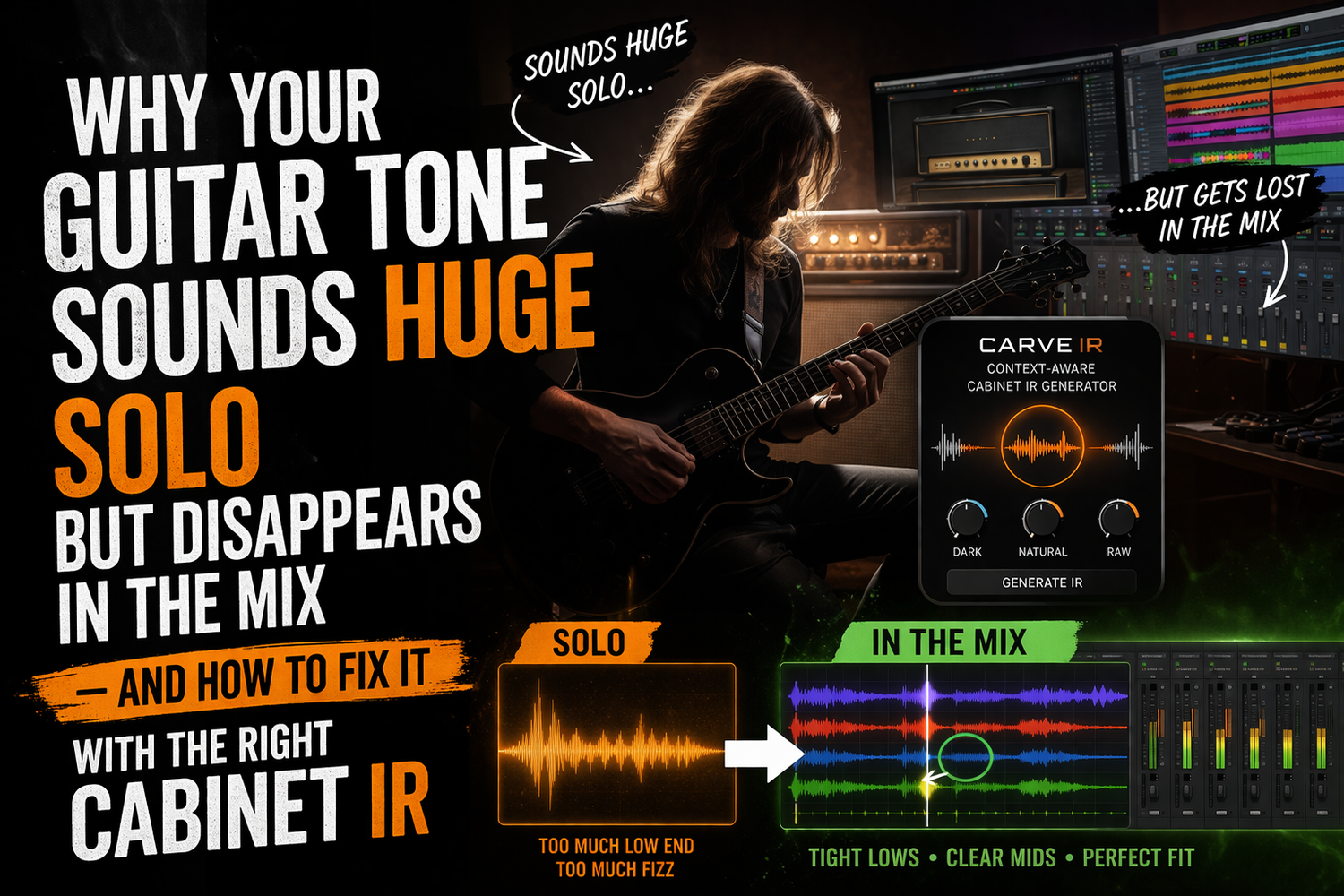
If you have ever dialed in a guitar tone that sounded absolutely massive on its own, only to hear it vanish the moment the drums and bass entered the song, you are not alone. In fact, this is one of the most common problems in modern guitar production.
A solo guitar tone can sound wide, deep, saturated, and exciting in isolation. It can have a huge low end, glossy top end, and a satisfying sense of size. But once that same tone is placed inside a real mix, everything changes. What felt full and powerful alone can suddenly feel muddy, fizzy, small, undefined, or completely buried.
Most guitarists first blame the wrong part of the signal chain. They blame the amp. They blame the pickups. They blame the plugin. They blame the guitar. Sometimes they even blame their playing. But very often, the real issue is much simpler:
The cabinet IR is wrong for the mix.
That is the part many players underestimate. They treat the cabinet IR as the final cosmetic touch, when in reality it is one of the biggest tone-shaping factors in the entire chain. The right IR can make almost any decent amp tone sit naturally inside a song. The wrong IR can make even a great amp sound unusable.
Let's break down why this happens, why solo tones are often misleading, and how choosing the right cabinet IR can completely change the way your guitars behave in a mix.
Why a Great Solo Tone Can Fail in a Full Mix
When you play guitar alone, your ears want the tone to feel complete. That usually means more low end, more sizzle, more width, more saturation, and more "wow factor." A tone like that feels inspiring. It fills the room. It sounds expensive.
But a mix is not built around what sounds impressive in solo.
A mix is built around separation, balance, and function.
The bass guitar already occupies the low end. The kick drum needs room to punch. The snare and vocals need the midrange to stay clear. Cymbals and air frequencies already live in the top end. So when your guitar tone is too full-range, it starts competing with everything at once.
That is why a guitar tone that feels huge by itself often disappears in context. It is not actually disappearing because it is too small. It is disappearing because it is trying to live everywhere instead of owning the right space.
In heavy music, this is even more obvious. Modern metal and hard rock mixes demand focus. Rhythm guitars usually need to be controlled, centered, and purposeful. They do not need exaggerated sub lows. They do not need endless fizz above the useful range. They need the right midrange shape so the listener can actually hear the notes, the pick attack, and the aggression once the entire arrangement is playing.
A mix-ready guitar tone is often less exciting in solo than a "fun" tone. That is normal. In fact, it is usually a good sign.
The Cabinet IR Is Not a Small Detail
A lot of players obsess over amp settings and barely think about the cabinet section. That is backwards.
The amp creates character, gain structure, feel, and response. But the cabinet IR determines a huge amount of what you actually hear as finished tone: low-end behavior, upper-mid focus, top-end texture, depth, boxiness, fizz, bite, and overall placement.
In other words, the cabinet IR is often the difference between:
- punchy and muddy
- aggressive and harsh
- clear and scooped
- wide and blurry
- mix-ready and impossible to place
Two IRs used with the exact same amp settings can sound like two completely different productions.
That is why simply swapping amps is often not the solution. Many players keep changing amp sims, chasing a result that is really an IR problem. They move from one plugin to another, from one model to another, from one preset pack to another, and still fight the same issue. The reason is simple: they are solving the wrong variable.
If the cabinet IR emphasizes too much low resonance, the tone will feel thick alone but collapse into mud in the mix. If it has too much upper fizz, it may sound exciting in solo but turn brittle and annoying once cymbals and vocals appear. If it is too scooped, the guitars may sound huge at first, but they will lose their ability to speak clearly when the arrangement gets dense.
What "Mix-Ready" Actually Means
"Mix-ready" is one of those phrases people use all the time, but it is often misunderstood.
A mix-ready guitar tone does not mean a polished, hyped, overproduced tone that sounds finished by itself.
It means a tone that naturally takes the right place inside a full arrangement with minimal corrective work.
That usually includes:
- controlled low end
- useful midrange information
- a top end that is present but not abrasive
- enough bite for articulation
- enough body for impact
- no excessive resonance fighting the bass and drums
A mix-ready tone supports the song instead of demanding constant repair.
When you load the right cabinet IR, you often notice something interesting: the guitar may sound slightly smaller in solo, but much bigger in the mix. That is the paradox many players have to learn. Great production is not about making every individual track sound enormous by itself. It is about making each track occupy the right role so the final record sounds enormous.
The Most Common Cabinet IR Mistakes
Let's look at the most common reasons guitars disappear or feel wrong in a mix.
1. Too Much Low End
This is probably the biggest one.
A guitar tone with lots of low resonance can feel heavy and satisfying in isolation. But guitars do not need true bass extension to sound powerful. In a dense mix, too much low content simply stacks up against bass guitar, kick drum, floor toms, and room energy. The result is less impact, not more.
The right IR should keep enough body to feel solid, while removing the kind of low-end bloom that turns rhythm guitars into a cloud.
2. Too Much Fizzy High End
Many modern guitar tones suffer from unnecessary top-end fizz. Alone, that can create the illusion of detail and aggression. In context, it often becomes a layer of irritation sitting above the useful guitar frequencies.
When cymbals, vocal air, and snare brightness are added, that fizzy guitar top end stops sounding "modern" and starts sounding cheap.
A better cabinet IR keeps the articulation while smoothing the garbage.
3. Scooped Mids
A scooped tone can sound massive in the room. It feels wide, deep, and aggressive. But the mids are exactly where guitars communicate. If they are too hollow in that area, the guitars lose presence and authority when the rest of the band comes in.
In rock and metal, the right midrange is what lets guitars sound expensive, intentional, and alive.
4. Wrong Focus for the Arrangement
Not every mix needs the same guitar shape. A very dense production with layered synths, triggered drums, and deep bass needs a different guitar focus than a raw, organic rock song. A cabinet IR that works brilliantly in one track may fail in another.
This is where many players get stuck. They keep asking, "What is the best IR?" when the real question is, "What IR works best in this specific mix?"
That is a completely different mindset.
Stop Judging Guitar Tones in Solo
One of the fastest ways to improve your guitar production is to stop making final decisions in solo mode.
Yes, soloing is useful for hearing noise, checking details, comparing settings, or identifying nasty resonances. But it is a terrible place to decide whether a guitar tone belongs in the song.
The correct workflow is simple:
- Build a decent base tone.
- Put it inside the full mix immediately.
- Compare changes while drums, bass, and important instruments are playing.
- Choose the version that works best in context, not the one that sounds coolest alone.
This sounds obvious, but most people still do the opposite. They spend an hour making a tone sound beautiful in solo, then wonder why it needs endless EQ once the mix starts.
A better cabinet IR often reduces that entire repair process. Instead of forcing the guitar into the track with aggressive post-EQ, you begin with a response that already belongs there.
Why Traditional IR Browsing Is So Frustrating
Anyone who has worked with large IR libraries knows the problem. You scroll through dozens or hundreds of files with vague names, tiny differences, and no clear relationship to the actual song you are mixing.
You audition one IR after another. One feels too dark. Another too sharp. Another too boxy. Another too soft. Another seems promising until the snare enters. Another sounds perfect until the bass comes back in. After thirty minutes, your ears are tired and you trust your judgment less than when you started.
The deeper issue is that traditional IR selection is usually disconnected from musical context. You are browsing static snapshots instead of solving a mix problem.
That is why context-aware approaches are so powerful. Instead of asking you to guess which generic IR might work, they start from the actual production situation: the amp tone you have, the mix around it, and the space the guitars need to occupy.
That is a much smarter way to think about cabinet tone.
The Smarter Approach: Context-Aware Cabinet IRs
The most useful modern workflow is not simply "find a good IR." It is:
Generate or choose an IR based on how the guitars need to behave in the actual song.
That is the core idea behind context-aware cabinet processing.
Rather than treating the IR like a fixed preset chosen in isolation, a context-aware method analyzes the production environment and shapes the cabinet response to fit that specific scenario more naturally. This can dramatically reduce the guesswork involved in finding a tone that stays powerful without masking everything around it.
This is exactly why tools like Carve IR are so interesting. Instead of thinking in terms of generic cabinet loading alone, the workflow is built around the relationship between the guitar tone and the mix. That is a major shift from the way most players have been working for years.
In practical terms, that means less endless IR scrolling, fewer wrong turns, and a better chance of landing on a tone that already behaves like it belongs in the record.
Dark, Natural, and Raw: Different Directions for Different Mixes
When working with cabinet tones, it helps to think in broad voicing directions rather than chasing a mythical "best" IR.
Dark
A darker IR can help when the guitar tone is overly sharp, fizzy, or fatiguing. It can be useful in bright digital chains, aggressive amp sims, or mixes where cymbals and vocals already dominate the upper range. Dark does not have to mean dull. The goal is controlled aggression without abrasive splash.
Natural
A more natural voicing is often the safest general-purpose choice. It keeps balance, preserves articulation, and avoids dramatic hype. For many mixes, this is the most flexible starting point because it gives you clarity without forcing the guitar too far in any one direction.
Raw
A rawer voicing can emphasize immediacy, bite, edge, and attitude. This can work beautifully in certain aggressive productions, especially where the guitars need more urgency and cut. But raw needs control. Too much rawness in the wrong mix can quickly become harsh or tiring.
These are not rigid rules. They are tonal directions. The important point is that the best choice depends on the song, not on internet hype.
How to Know Your Guitar Tone Is Finally Working
A guitar tone is probably in the right place when:
- it feels easier to hear without turning it up
- palm mutes feel tighter and more defined
- the bass stays strong instead of collapsing
- the snare remains punchy
- vocals keep their space
- the guitars sound aggressive without constant EQ surgery
- the full mix feels bigger, not just the guitar track
That last one matters most.
A good cabinet IR does not only improve the guitar. It improves the behavior of the entire mix around the guitar. It reduces conflict. It improves separation. It makes the arrangement feel more intentional.
That is why the cabinet stage deserves far more attention than it usually gets.
A Practical Workflow for Better Guitar IR Decisions
Here is a simple workflow you can use right away:
Start with a solid amp tone, but do not obsess over perfection. Get the gain structure and general feel right first.
Then load a cabinet IR and immediately listen in the context of the full track. Focus on how the guitars interact with kick, snare, bass, cymbals, and vocals.
Ask the right questions:
- Do the guitars mask the bass?
- Are the upper frequencies irritating when cymbals enter?
- Do the notes stay readable in busy sections?
- Do the guitars sound powerful without swallowing everything else?
Compare only a few meaningful options instead of browsing endlessly. If one direction clearly supports the mix better, commit and move on.
And most importantly, do not confuse "bigger in solo" with "better in production."
Final Thoughts
If your guitar tone sounds huge alone but disappears in the mix, the problem is probably not that your rig is not good enough. It is probably that your cabinet IR is not doing the right job for the song.
That is actually good news, because it means the fix is often closer than you think.
The right cabinet IR can tighten the low end, clean up the fizz, restore the useful mids, and help the guitars sit exactly where they need to sit. It can turn a frustrating tone into a mix-ready one without forcing you to rebuild your whole signal chain from scratch.
This is one of the biggest mindset shifts in modern guitar production:
Stop chasing the most impressive solo tone. Start chasing the tone that makes the full mix hit harder.
Once you begin choosing cabinet IRs based on context instead of isolation, everything gets easier. Your guitars need less correction. Your mixes come together faster. And the final result sounds more intentional, more professional, and more powerful.
That is the real goal.
And if you want a faster, smarter way to stop guessing and start building cabinet tones around the actual song, that is exactly where a context-aware workflow becomes a serious advantage.




Leave a comment
All comments are moderated before being published.
This site is protected by hCaptcha and the hCaptcha Privacy Policy and Terms of Service apply.