


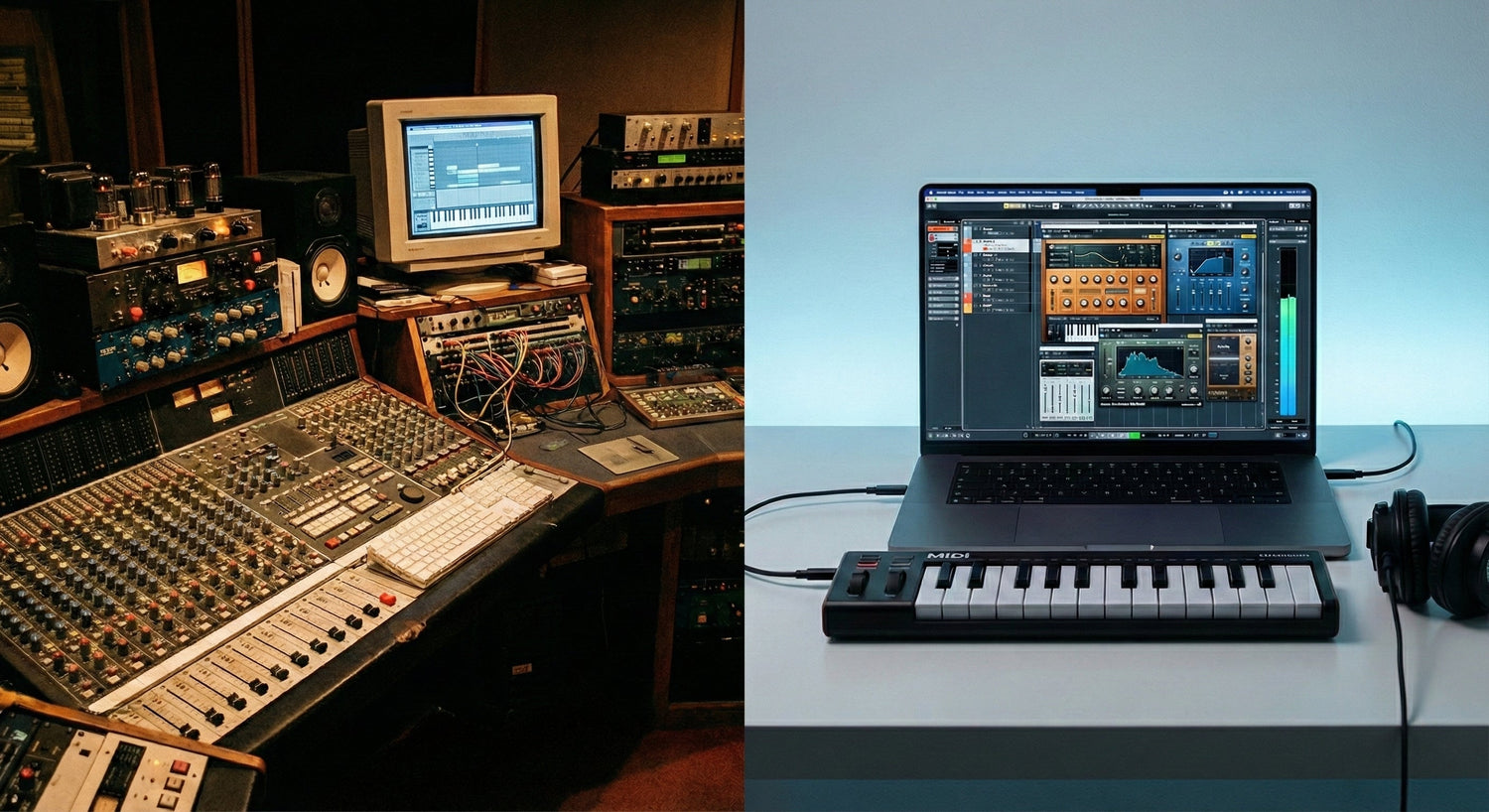
If you walked into a professional recording studio in 1990, you would have been greeted by walls of blinking lights. Compressors, equalizers, reverbs, and synthesizers were physical, heavy, expensive boxes connected by a nightmare of cables.
Today, that entire room fits inside a backpack.
The technology that made this shrinking act possible is VST (Virtual Studio Technology). While we take it for granted today, the ability to load a compressor or a synthesizer as a piece of software was a radical idea that democratized music production forever.
Here is the complete history of how Steinberg’s VST standard changed the world of audio.
The Dark Ages: Before 1996
To understand the revolution, we must understand the limitation. In the early 90s, computers (Atari ST, early Macs, and PCs) were essentially just "digital conductors."
They ran MIDI Sequencers, sending data notes to external hardware synthesizers. If you wanted to process audio inside the computer, you needed expensive, proprietary DSP (Digital Signal Processing) cards like Digidesign’s TDM system. The average consumer CPU (like a 90MHz Pentium) simply wasn't fast enough to handle real-time audio.
1996: The Big Bang (VST 1.0)
In 1996, the German software company Steinberg released Cubase VST 3.02. It was a watershed moment.
For the first time, the computer's native CPU was used to process audio effects in real-time. You didn't need external hardware; you just needed the software.
-
The Limitation: VST 1.0 was strictly for effects (Reverb, Delay, Chorus, EQ). It could not generate sound, only manipulate it.
-
The Masterstroke: Steinberg made the VST SDK (Software Development Kit) open-source and free.
By allowing third-party developers to write plugins for their platform, Steinberg destroyed the competition (specifically Microsoft's DirectX audio format). A standard was born.
Note: Alongside VST, Steinberg introduced ASIO (Audio Stream Input/Output). This driver protocol allowed low-latency communication between software and soundcards, making real-time monitoring possible on Windows.
1999: The Game Changer (VST 2.0 and VSTi)
If 1996 was the spark, 1999 was the explosion. Steinberg released VST 2.0, introducing a concept that defines modern music production: VSTi (Virtual Studio Technology Instrument).
Previously, plugins only processed audio. Now, plugins could receive MIDI data. This meant software could act as a synthesizer or a sampler.
-
Neon: Included with Cubase, Neon was a simple 2-oscillator synth. It sounded thin by today's standards, but it proved the concept worked.
-
Model E: Shortly after, the Model E (a Minimoog emulation) proved that software could actually sound good.
This era birthed the giants of the industry. Companies like Native Instruments emerged, releasing the legendary Pro-52 (a Prophet-5 emulation), proving that a $200 piece of software could rival a $2,000 vintage synth.
2000–2006: The Golden Age of Freeware
As CPUs became powerful (thanks to the Pentium 4 and Athlon XP), a massive community culture developed.
Tools like SynthEdit and SynthMaker allowed non-programmers to build their own VSTs graphically. This led to a flood of thousands of free plugins. Websites like KVR Audio became the hub for "Bedroom Producers" who could suddenly afford to make professional-sounding music for free.
During this time, VST 2.4 became the industry standard. It introduced 64-bit audio processing and was so stable that many producers still use VST 2.4 plugins today, nearly two decades later.
2008: The Modern Era (VST 3.0)
Steinberg released VST 3.0 in 2008. It was a complete rewrite of the code, not just an update.
Initially, adoption was slow. Developers hated rewriting their plugins, and VST 2.4 "just worked." However, VST 3 introduced critical features for the modern age:
-
Silence Detection: If no audio is passing through a plugin, it automatically turns off to save CPU power.
-
Dynamic I/O: Plugins could automatically adapt to Mono, Stereo, or 5.1 Surround sound.
-
Sample Accurate Automation: Automation became much tighter and more precise.
-
Note Expression: This allowed producers to modulate specific notes within a chord, paving the way for today's MPE (MIDI Polyphonic Expression) controllers.
2018–Present: The End of VST 2 and the Rise of AI
In recent years, Steinberg has officially discontinued the VST 2 SDK. New developers can no longer legally obtain a license to create VST 2 plugins. The industry is being forced toward VST 3, especially with the transition to Apple Silicon (M1/M2/M3 chips), which favors the newer architecture.
Where are we going next?
-
CLAP (CLever Audio Plug-in): In response to Steinberg’s strict licensing, companies like u-he and Bitwig have launched CLAP, an open-source, liberal license format designed to be faster and more flexible than VST.
-
AI Integration: The new frontier is plugins that use Neural Networks. We are seeing VSTs that can "listen" to your track and automatically EQ it (like iZotope Neutron), or separate a mixed song into stems in real-time.
Conclusion
From the humble beginnings of the Neon synth to AI-powered mastering suites, the history of VST is the history of the "Studio in a Box." Steinberg’s decision to open up their format in 1996 didn't just change software; it changed who could afford to be a musician.



Leave a comment
All comments are moderated before being published.
This site is protected by hCaptcha and the hCaptcha Privacy Policy and Terms of Service apply.