


The Universal Audio 6176 is one of the most revered channel strips in professional audio — a combination of the legendary 610 tube preamp and the iconic 1176 FET compressor in a single 2U unit. It has graced countless hit records, from rock and metal to pop and hip-hop. There is just one problem: it costs over $3,500. For most home studio owners, that is simply not an option.
Enter the Behringer 676, a bold and unapologetic clone of the UA 6176 that aims to deliver the same tube-preamp-plus-FET-compressor formula at roughly one-seventh of the price. At around $469 MSRP (street prices hovering near $619 in the US), it promises real vacuum tubes, Midas-designed custom transformers, and genuine 1176-style compression — all in a package that will not bankrupt your studio budget.
But can a sub-$500 channel strip really capture the magic of a $3,500+ legend? We spent weeks putting the Behringer 676 through its paces on vocals, guitars, bass, and more. Here is our honest, in-depth review.
What Is the Behringer 676?
To understand the Behringer 676, you first need to understand what it is cloning. The Universal Audio 6176 is a channel strip that combines two of the most iconic pieces of studio hardware ever made:
- The UA 610 Tube Preamp — a design dating back to the 1960s, known for its rich, warm harmonic character and musical EQ. It was the preamp behind early Capitol Records sessions and has been a studio staple for over six decades.
- The UA 1176 FET Compressor — arguably the most famous compressor in recording history. Its ultra-fast attack, punchy transient control, and musical compression character have made it indispensable on vocals, drums, guitars, and virtually everything else.
The UA 6176 combines both units into a single 2U rackmount package with an internal signal path that flows from preamp to compressor. It is a tracking workhorse — plug in a microphone, dial in your tone, and print it to your DAW with world-class analog character baked in.
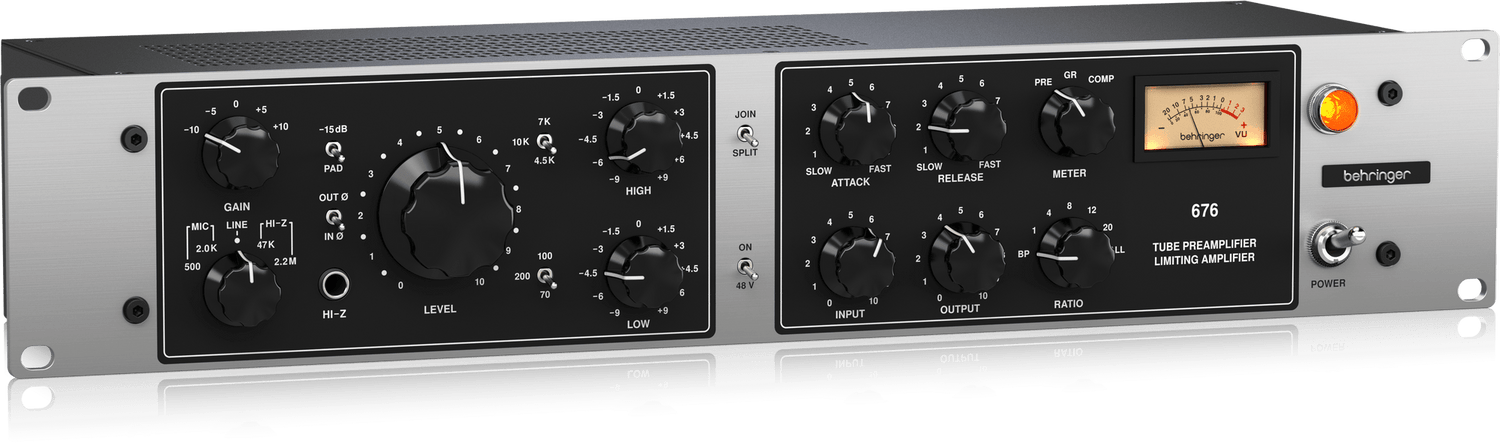
The Behringer 676 recreates this concept faithfully. It is a 2U rackmount unit featuring a tube preamp section with real vacuum tubes and a FET compressor section modeled after the 1176 topology. Behringer uses premium 12AX7/ECC83S and 12AT7/6072 tubes, Midas-designed custom input and output transformers, and a full complement of compressor controls including variable attack, release, and ratio.
In short, it is Behringer's attempt to democratize one of the most coveted signal chains in professional audio. And on paper, it ticks every box.
Build Quality and First Impressions
The Behringer 676 arrives in a sturdy box with foam inserts protecting the unit. Unboxing it, the first thing you notice is the weight — at roughly 5 kilograms (about 11 pounds), it has genuine heft for a Behringer product. This is a full metal chassis, not plastic, and it feels reassuringly solid in your hands.
The front panel is laid out logically. On the left side, you have the preamp section with a large gain knob, a level control, a polarity switch, a pad switch (-20dB), and the 2-band EQ with selectable frequency switches. In the center sits a classic-style VU meter that can be switched to show input level or gain reduction — a nice touch that adds both functionality and visual appeal. The right side houses the compressor section with input and output knobs, attack and release controls, and a ratio selector.
The back panel is straightforward: balanced XLR input and output, plus the IEC power connector with a universal power supply supporting 100-240V. The unit will work anywhere in the world without a voltage converter.
Now, for the honest assessment. The knobs feel acceptable but not luxurious. They are smooth enough to dial in settings precisely, but they lack the dampened, weighted feel of high-end units like the original UA 6176. The switches are functional and click positively. The VU meter backlighting gives the unit a professional look in a rack. Overall, for the price point, the build quality is genuinely impressive — this is miles above what Behringer was producing a decade ago.
The Tube Preamp Section — Sound and Character
Tube Warmth and Gain Structure
The heart of the Behringer 676's preamp section is its pair of vacuum tubes: a 12AX7/ECC83S and a 12AT7/6072. These are not exotic tubes by any means, but they are proven, reliable designs that have been the backbone of tube audio for decades. Combined with the Midas-designed custom input and output transformers, they form a signal path that genuinely adds harmonic character to your audio.
With up to 64dB of gain available, the preamp has plenty of headroom for virtually any microphone. Dynamic mics like the Shure SM7B or Sennheiser MD421, which are notorious for needing a lot of gain, work comfortably with the 676. Condenser and ribbon mics have even more room to breathe.
At lower gain settings, the preamp is surprisingly clean and open. You get a subtle warmth — a gentle thickening of the low-mids and a slight smoothing of the top end that is characteristic of transformer-coupled tube designs. As you push the gain higher, the tube saturation becomes more apparent. You start hearing even-order harmonics creeping in, adding that coveted "glow" to vocals and instruments.
Is it as refined as the original UA 610? No. The UA 610 has a silkier, more three-dimensional quality — a depth and openness that comes from decades of refined circuit design and hand-selected premium components. The Behringer 676's preamp is a touch more forward and slightly grainier in the high frequencies when pushed hard. But here is the important part: it genuinely sounds like a tube preamp, not a solid-state preamp trying to fake warmth. The harmonic richness is real, and in a mix context, it adds character that you simply cannot replicate with plugins.
The EQ Section
The 676 features a 2-band shelving EQ with switchable frequency points:
- Low shelf: 70 Hz, 100 Hz, or 200 Hz
- High shelf: 4.5 kHz, 7 kHz, or 10 kHz
Each band offers boost and cut via a single knob. This is not a surgical parametric EQ — it is a broad, musical equalizer designed for tonal shaping during tracking.
In practice, the EQ is more useful than you might expect from just two bands. The low shelf at 100 Hz is perfect for adding body to thin vocals or acoustic guitars. The 200 Hz position is great for cutting mud on proximity-heavy sources. On the top end, the 10 kHz shelf adds a beautiful air and shimmer to vocals and cymbals, while the 4.5 kHz position can add presence and bite to electric guitars.
The key is to use it gently. A couple of dB of boost or cut during tracking can shape a source beautifully without committing to anything drastic. Think of it as flavoring, not correction — save the corrective EQ for your DAW.
The FET Compressor — 1176-Style Dynamics
If the tube preamp gives the Behringer 676 its warmth, the FET compressor gives it its punch. This section is modeled after the Universal Audio 1176 topology — a Field Effect Transistor design known for its incredibly fast response and aggressive, musical compression character.
The compressor controls include:
- Input: drives the signal into the compressor (effectively the threshold)
- Output: makeup gain after compression
- Attack: 20 to 800 microseconds — extremely fast at the lowest setting
- Release: 50 to 1100 milliseconds
- Ratio: continuously variable from 1:1 to 100:1
Like the original 1176, the Behringer 676's compressor operates on an input/output gain structure rather than a traditional threshold control. You drive more signal into the compressor by increasing the input, and the compression reacts accordingly. This approach is intuitive once you get used to it: more input equals more compression.
The attack range of 20 to 800 microseconds is key to the 1176 character. At its fastest setting, the compressor can catch the very leading edge of a transient, producing a slightly rounded, smooth attack. At slower settings, transients punch through before the compressor clamps down, creating that snappy, dynamic feel that the 1176 is famous for on drums and vocals.
The ratio range from 1:1 to 100:1 is impressively wide. At lower ratios (around 4:1), you get smooth, transparent leveling that is perfect for vocal tracking. At higher ratios (12:1 to 20:1), the compressor becomes aggressive and punchy — ideal for smashing room mics, adding sustain to guitars, or creating that thick, in-your-face vocal sound. And at extreme ratios approaching 100:1, you are essentially in limiter territory, which can produce the sought-after "all buttons in" saturation character that engineers have loved on the 1176 for decades.
On vocals, the 676's compressor delivers smooth, controlled leveling that keeps performances sitting perfectly in a mix. The fast attack tames harsh consonants and sibilance without sounding unnatural, while a medium release lets the natural dynamics of the performance breathe.
On electric guitars, the FET compression adds sustain and thickness that is particularly flattering for rock and metal tones. DI guitar signals benefit enormously — the combination of tube preamp warmth and FET compression punch creates a DI tone that is genuinely inspiring to play through. If you are using amp simulation plugins, recording your DI through the 676 before hitting your amp sim can add a dimension of analog character that is hard to replicate otherwise. (If you are exploring amp sims, check out our best DAW for rock and metal guide for software recommendations.)
On bass guitar, the compressor excels at taming the wide dynamic range that bass instruments produce. A moderate ratio with a medium-fast attack tames the initial pluck while preserving the body and sustain of each note. The result is a bass tone that sits solidly in the mix without pumping or losing definition. For more on compression techniques, our best compressors for drum mixing article covers complementary approaches.
Join vs Split Mode — Flexibility in Routing
One of the Behringer 676's most practical features is its Join/Split switch, which changes how the preamp and compressor sections interact.
In Join mode, the signal flows directly from the tube preamp into the FET compressor in series. This is the classic channel strip workflow: plug in your microphone, set your preamp gain, dial in your EQ, adjust the compressor, and print a fully processed signal to your DAW. It is fast, efficient, and perfect for tracking sessions where you want to commit to a sound.
In Split mode, the preamp and compressor operate independently. This opens up several creative and practical possibilities:
- Use the compressor on already-recorded tracks: Send a line-level signal from your audio interface into the compressor section for analog compression during mixing. This is a fantastic way to add FET compression character to tracks without buying a standalone 1176 clone.
- Use the preamp alone: If you only need tube warmth and EQ shaping without compression, split mode lets you use the preamp section as a standalone tube preamp.
- Insert the compressor on a different signal path: Route the compressor into an insert loop on your mixer or audio interface for flexible processing options.
This flexibility significantly increases the value proposition of the 676. You are essentially getting two pieces of gear in one — a tube preamp and an 1176-style compressor — and the ability to use them together or separately depending on your needs.
Behringer 676 vs Universal Audio 6176 — The Real Comparison
Let us address the elephant in the room. How does a $469-619 Behringer compare to a $3,500+ Universal Audio original? Here is our honest, side-by-side assessment:
The tubes are nominally the same type in both units (12AX7 and 12AT7), but Universal Audio uses hand-selected, tested tubes that are matched for optimal performance. The Behringer uses quality tubes, but without the same level of screening. In practice, this means the UA has a slightly more refined, consistent harmonic character, while the Behringer may have minor unit-to-unit variation.
The transformers are where much of the sonic difference lives. UA's custom transformers are designed with higher headroom and a more nuanced frequency response. The Midas-designed transformers in the 676 are genuinely good — they add real color and weight — but they lack the last degree of openness and clarity that the UA transformers provide, particularly in the top end.
The compressor sections are both FET-based and both deliver that 1176 character of fast, punchy compression. The Behringer gets roughly 80% of the way to the UA's compressor performance. The attack response is similar, the compression character is recognizably 1176-flavored, and the overall feel is musical and dynamic. Where the UA pulls ahead is in subtlety — at light compression settings, the 6176's compressor is more transparent and controlled, while the 676 can introduce a slightly grittier texture.
The honest verdict: The Behringer 676 captures the spirit and general character of the UA 6176 convincingly. It gets you roughly 80-90% of the usable sonic benefit at approximately 15% of the cost. For the vast majority of home studio recordings, that remaining 10-20% is genuinely inaudible in the context of a full mix. The UA 6176 justifies its price in professional studios where every fraction of a percent matters and the gear will be used daily for decades. For home studios, the Behringer 676 delivers remarkable value.
If you are interested in how other affordable gear compares to expensive originals, our Behringer 1273 Neve clone review covers similar territory in the Neve preamp space.
Best Use Cases for the Behringer 676
Vocals
This is where the 676 truly shines. Rock and metal vocals benefit enormously from the combination of tube warmth and FET compression. The preamp adds body and presence to a vocal performance, while the compressor keeps dynamics controlled without squashing the life out of the delivery. For screaming, growling, and aggressive vocal styles, the tube saturation at higher gain settings adds a gritty edge that sits perfectly in a dense mix. For clean singing, a more conservative gain setting delivers smooth warmth that helps vocals cut through guitars without sounding harsh.
Electric Guitar — DI and Reamping
Recording electric guitar DI through the 676 is a revelation compared to going straight into an audio interface (for help choosing the right one, see our best audio interface guide). The tube preamp adds harmonic complexity and a sense of "life" to the raw DI signal, which then translates into more realistic and dynamic tones when processed through amp simulation plugins. The compressor can add sustain for lead work or tighten up rhythm parts.
For reamping, the 676 can be used in split mode to compress the signal path, adding analog dynamics processing to your reamped tones. This is particularly useful for metal production where tight, controlled guitar tones are essential.
Bass Guitar
Bass guitar is one of the most challenging instruments to record well, largely because of its extreme dynamic range. The 676's FET compressor handles bass beautifully. A moderate ratio (4:1 to 8:1) with a medium attack lets the initial note transient through for definition, then smoothly compresses the sustain for even, controlled bass tones. The tube preamp adds the warmth and weight that makes bass recordings feel "expensive" — that full, round character that plugins struggle to replicate.
Acoustic Instruments
While the 676 is not the first choice for pristine, transparent acoustic recording, it excels when you want to add character. Acoustic guitars gain a warm, vintage quality that is perfect for singer-songwriter productions or adding depth to strummed parts in a rock mix. The EQ section is particularly useful here — a gentle high shelf boost at 10 kHz adds sparkle to acoustic guitar without harshness, while the low shelf at 100 Hz can add body to thin-sounding instruments.
Who Should (and Should Not) Buy the Behringer 676?
The Behringer 676 is an excellent choice for:
- Home studio owners who want real analog warmth and character without spending thousands.
- Rock and metal producers who need tube preamp saturation and punchy FET compression for vocals and guitars.
- Budget-conscious engineers who understand the value of analog front-end processing but cannot justify $3,500+ on a single channel strip.
- Content creators and podcasters who want their voice to sound richer and more professional.
- Musicians building their first outboard rack — the 676 is an outstanding starting point that covers both preamp and compression needs in a single unit.
The Behringer 676 may not be the best choice for:
- Professional commercial studios that demand the absolute highest fidelity and can invest in premium gear for daily, heavy-duty use.
- Mastering engineers who need ultra-transparent, precision processing with the highest possible headroom.
- People who already own high-end channel strips — if you have a real 6176, API 512c, or Neve 1073, the 676 will not offer a meaningful upgrade.
One important consideration: if your workflow is entirely digital — using amp simulations, virtual instruments, and in-the-box mixing — you may not need hardware processing at all. Software tools have gotten remarkably good. But if you want to add genuine analog character at the recording stage, the Behringer 676 offers extraordinary value for money. Pair it with quality presets for your amp sim or drum software, and you have a powerful hybrid setup that punches well above its weight class.
For those exploring the plugin side of channel strip processing, our SSL channel strip plugin shootout is worth reading. And if you are looking into hardware compressor emulations in plugin form, our Distressor compressor review covers another legendary dynamics processor.
Key Specifications
Final Verdict — Our Rating
The Behringer 676 delivers outstanding value — genuine tube warmth, punchy FET compression, and flexible routing in a single 2U unit. At this price point, nothing else comes close to offering a real tube preamp combined with an 1176-style compressor.
PROS
- + Genuine tube preamp with real harmonic warmth
- + Musical 1176-style FET compressor
- + Midas-designed custom transformers
- + 64dB of gain — handles any microphone
- + Join/Split mode for flexible routing
- + Useful 2-band EQ for tracking
- + Universal power supply (100-240V)
- + Exceptional price-to-performance ratio
CONS
- - Knobs lack the premium feel of high-end units
- - Slightly grainier top end than the original UA 6176
- - Single channel only (need two for stereo)
- - No digital connectivity (XLR analog only)
- - Potential unit-to-unit tube variation
The Behringer 676 is not trying to be the best channel strip ever made. It is trying to bring legendary channel strip character to studios that could never afford the original — and in that mission, it succeeds brilliantly. For home studio musicians and rock/metal producers on a budget, this is one of the smartest gear investments you can make in 2026.
Whether you are tracking vocals through the tube preamp, compressing bass through the FET section, or warming up guitar DI signals before they hit your amp sims, the 676 delivers real analog character that will elevate your recordings in ways that plugins alone cannot match.
Pair your Behringer 676 with professional presets from Develop Device
Take your recordings even further with our studio-quality presets and templates. From guitar amp presets for Fractal, Kemper, Helix, and Neural DSP to professionally crafted Superior Drummer 3 presets and mixing templates — we have everything you need to achieve radio-ready rock and metal tones.




Leave a comment
All comments are moderated before being published.
This site is protected by hCaptcha and the hCaptcha Privacy Policy and Terms of Service apply.