


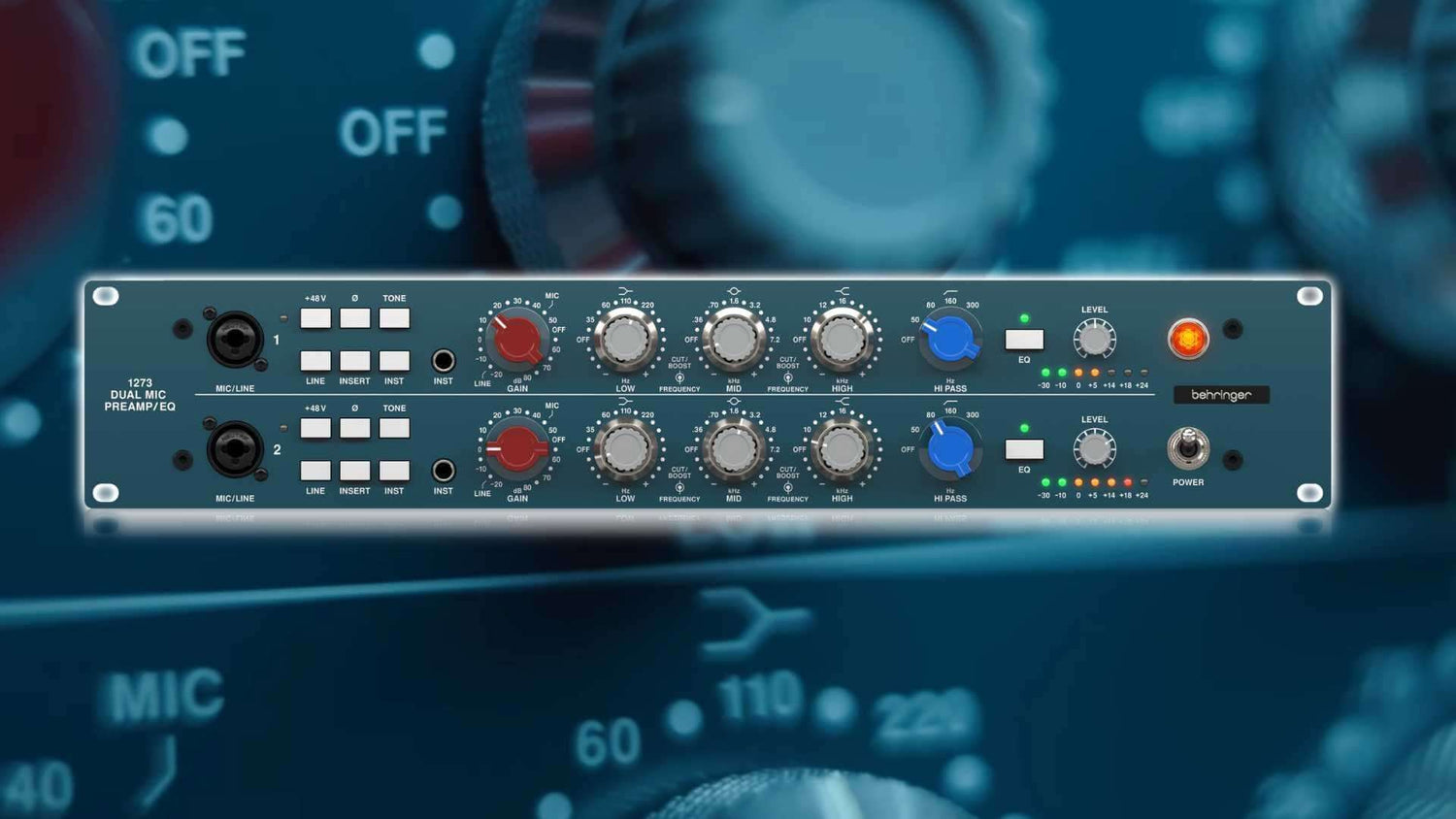
In the world of music production, the quest for the perfect preamp is a journey many engineers take seriously. The Neve 1073 preamp has earned legendary status — its warm, rich sound is synonymous with some of the greatest recordings in history. However, the $3,000+ price tag makes it an unattainable dream for many. Enter Behringer with their take on the classic: the Behringer 1273. But does this budget-friendly preamp live up to the legacy? Let's dive into our hands-on review.
Behringer 1273 Specifications
| Feature | Specification |
|---|---|
| Type | 2-Channel Microphone Preamplifier & EQ |
| Preamp Gain | Up to 80 dB |
| EQ Low Band | 35Hz - 220Hz (5 positions) |
| EQ Mid Band | 360Hz - 7.2kHz (6 positions) |
| EQ High Band | 10kHz - 16kHz (fixed shelf) |
| Highpass Filter | 5 positions (50Hz-300Hz) |
| DI Input | Yes (front panel, per channel) |
| Phantom Power | 48V (per channel) |
| Connectors | XLR in/out, 1/4" DI in, 1/4" line out |
| Price (2026) | ~$349 USD |
Design and Build Quality
The Behringer 1273 gives off a solid first impression. Its design is clearly inspired by the classic Neve aesthetic, with a rugged metal chassis and a functional, no-nonsense layout. The knobs and switches feel reasonably sturdy — not as luxurious as on a real Neve or even a Warm Audio WA-73, but commendable for the price point. The dual-channel design means you get two independent preamp/EQ chains, making it excellent for stereo recording or tracking two sources simultaneously.
Sound Quality: How Close to a Real Neve?
The million-dollar question: does the Behringer 1273 sound like a Neve 1073? The short answer is close, but not identical.
When it comes to warmth and character, the Behringer 1273 does a surprisingly good job of capturing the essence that makes the Neve so revered. The low-end is full and rounded, adding pleasant weight to vocals and instruments alike. The midrange is where the 1273 really shines — it delivers a smooth, musical presence that helps sources sit nicely in a mix.
However, for those familiar with the true Neve sound, differences emerge in the top end. The original 1073 is known for its incredibly detailed and open high frequencies, giving recordings a sense of air and space. The Behringer 1273's highs feel a bit more restrained, lacking that shimmering quality the Neve is famous for. That said, for the price, the 1273 offers a surprisingly pleasing sound that many budget-conscious producers will find more than acceptable.
To further shape your dynamics after tracking through the 1273, consider using the Distressor compressor for added punch and character.
EQ Section: The Hidden Gem
What many reviewers overlook is the 1273's EQ section — and it's actually one of its strongest features. The 3-band EQ with selectable frequencies mirrors the classic 1073 topology:
- Low band (35Hz-220Hz): Adds weight without muddiness. The 110Hz and 220Hz settings are particularly musical on vocals and guitars.
- Mid band (360Hz-7.2kHz): This is a cut-only band with 6 selectable frequencies — perfect for surgical removal of boxy or harsh frequencies.
- High shelf (10kHz-16kHz): Adds air and presence. More subtle than the Neve original, but still effective.
The 5-position highpass filter (50Hz to 300Hz) is invaluable for cleaning up proximity effect on vocals or rumble on acoustic instruments.
Behringer 1273 vs Alternatives (2026 Comparison)
| Preamp | Price | Channels | EQ | Sound |
|---|---|---|---|---|
| Behringer 1273 | $349 | 2 | 3-band + HPF | Warm, slightly dark top |
| Warm Audio WA-73 | $599 | 1 | None | Closer to Neve, open top |
| Warm Audio WA-73EQ | $799 | 1 | 3-band + HPF | Excellent Neve clone |
| Golden Age Premier PRE-73 MKIV | $499 | 1 | None | Very close to Neve |
| AMS Neve 1073SPX | $3,495 | 1 | 3-band + HPF | The real deal |
The Behringer 1273 wins on value per channel — you get two channels with EQ for less than a single-channel Warm Audio WA-73. For a home or project studio, that's a significant advantage.
Who Should Buy the Behringer 1273?
- Home studio owners who want Neve-style warmth without breaking the bank
- Producers who need two channels — stereo drum overheads, recording two vocalists, or DI + mic simultaneously
- Guitar/bass players who want to track through a real preamp with DI input
- Budget-conscious engineers upgrading from an audio interface's built-in preamps
If you're a working professional who needs the absolute Neve sound, invest in the real thing or at least a Warm Audio WA-73EQ. But for 90% of home recordings, the Behringer 1273 gets you remarkably close.
Known Limitations
- Noise at high gain: Above 60 dB of gain, you'll notice increased noise floor — common for budget preamps. Use a Cloudlifter for low-output dynamic mics.
- Top-end detail: Not as open and airy as the original Neve 1073. The high shelf feels more restrained.
- Internal components: While the circuit topology mirrors the Neve, the transformers and op-amps are different, which accounts for the sonic differences.
Final Verdict
The Behringer 1273 is not a Neve 1073, and it doesn't claim to be. Instead, it's an affordable gateway to the Neve sound that brings warmth and character to a price point accessible to a much wider audience. At $349 for two channels with EQ, it's arguably the best value Neve-style preamp on the market in 2026.
For those on a budget, the Behringer 1273 is a compelling choice. Whether you're tracking vocals, instruments, or looking to add analog color to your recordings, it's a preamp worth serious consideration. Once your signal is tracked, shape it further with the right SSL channel strip plugin or one of the best compressors for drum mixing.
If you're exploring Behringer's analog lineup, also check out our Behringer 676 review — their impressive UA 6176-style tube channel strip.
Frequently Asked Questions
Is the Behringer 1273 a true Neve 1073 clone?
It follows the same circuit topology as the Neve 1073, but uses different transformers and components. The result is similar warmth and character, but the top-end detail and "air" of the original Neve isn't fully replicated. For the price ($349 vs $3,495), it gets remarkably close.
Can I use the Behringer 1273 for professional recordings?
Yes, for most applications. Many professional studios use it as a secondary preamp or for scratch tracks. The key limitation is noise at very high gain settings. For quiet sources like ribbon microphones, you may need a Cloudlifter or similar gain booster.
Behringer 1273 vs Warm Audio WA-73: which is better?
The Warm Audio WA-73 ($599) is closer to the original Neve sound, especially in the high frequencies. However, the Behringer 1273 ($349) gives you two channels with EQ for less money. If sound quality per channel is your priority, go Warm Audio. If value and dual-channel flexibility matter more, the Behringer wins.



1 comment
Tom Vibe
Indeed as U say finest detail and depth are not comparable in critical listening. What I am wondering is could there be some mod made. Behringer has input as well as output transformers some of them switched or bridged should bring in more detail first as well as using some high end opamps, transistors and capacitors … Anyway this is very honest and insightful review. Thanx and have a great day
Leave a comment
All comments are moderated before being published.
This site is protected by hCaptcha and the hCaptcha Privacy Policy and Terms of Service apply.